
Office Address
5th Floor, Mpelembe House
Ndola, Zambia
Phone Number
+260 (955) 367 762
+260 (966) 949 783
Email Address
info@trackex.io
support@trackex.io
5th Floor, Mpelembe House
Ndola, Zambia
+260 (955) 367 762
+260 (966) 949 783
info@trackex.io
support@trackex.io







 by Mapsaels Design
The global logistics industry is growing at an unprecedented pace, with the market expected to reach USD 14.08 trillion by 2028. But rapid growth brings new demands from delivering faster and cutting costs to reducing operational risks and keeping customers informed in real time. In this high-stakes environment, traditional GPS navigation are quickly becoming outdated.
Many logistics operations still rely on basic navigation tools that offer static routing and delayed updates. This often leads to missed delivery windows, rising fuel expenses, and inefficient resource planning challenges modern logistics businesses can no longer afford to ignore.
That’s where Artificial intelligence-based GPS navigation is changing the game.
Unlike conventional systems, AI-powered GPS tools do more than map a route. They learn from traffic patterns, analyze real-time conditions, and make smart decisions to keep deliveries on track and fleets running efficiently. These systems adapt to live traffic, weather changes, driver behavior, and delivery urgency all while helping you operate leaner and smarter.
If your logistics operation is still running on outdated tech, it’s time to rethink your strategy. This blog explores why AI-based GPS navigation is the future of logistics, and how it can help your business gain a competitive edge in 2025 and beyond.
AI-based gps navigation is an advanced system that uses artificial intelligence, machine learning, and real-time data to improve routing and decision-making. It learns from past routes, analyzes live conditions, and adjusts instantly.
Unlike traditional GPS that relies on static routes, AI systems dynamically adapt to:
This makes them ideal for logistics companies managing multiple deliveries, vehicles, and regions.
Before diving into the benefits, it’s important to understand the limitations of legacy GPS tools.
Key drawbacks:
In logistics, these limitations lead to delays, higher fuel costs, missed ETAs, and frustrated customers.

Let’s break down how AI is revolutionizing logistics operations:
1. Smarter route optimization
AI-powered navigation continuously analyzes traffic, road conditions, and vehicle data to choose the most efficient route, not just the shortest.
2. Real-time rerouting
If there’s a sudden delay ahead, AI adjusts the route instantly.
3. Fuel and cost efficiency
Fleets using AI-based routing often see major savings.
4. Better driver and asset management
AI tracks driver behavior such as speeding, harsh braking, or unnecessary idling.
5. Improved customer experience
Your clients care about timely deliveries and clear tracking.
6. Data-driven decision making
AI tools generate detailed reports on route performance, driver behavior, fuel use, and delivery success.

Cold-chain transport
AI GPS ensures timely delivery of temperature-sensitive goods by avoiding traffic and prioritizing quick routes.
E-commerce last mile
Predictive AI navigation reduces delivery failures and ensures packages arrive on time even in dense city zones.
Emergency logistics
AI calculates fastest safe routes in real-time during crises like floods, strikes, or traffic blackouts.
Let’s bust a few:
Not all AI navigation tools are created equal. Before investing, check for:
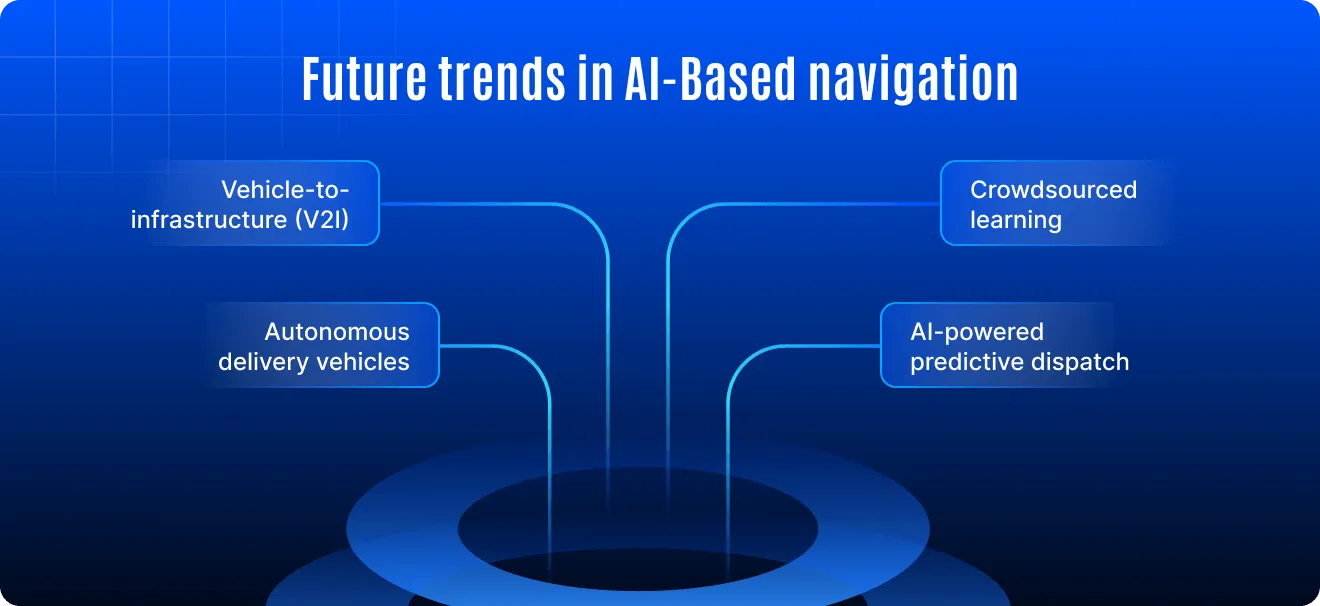
AI-based GPS navigation is just getting started.
In the next 3–5 years, expect:
AI-based GPS navigation isn’t a luxury, it’s becoming a logistics necessity.
To recap, it helps businesses:
Stay competitive in a fast-moving market